
A god that is all-loving, yet capable of eternal punishment.
A creator of everything, yet demanding worship.
A being beyond human understanding, yet deeply concerned with obedience.
At first glance, these ideas are accepted as divine mystery. But when placed side by side, they form a tension that is hard to ignore. Not emotionally—but logically.
What if the contradiction isn’t in our understanding of God…
but in the assumption that the creator described in major religions is the highest form of divinity?
A Shared Foundation
The three major monotheistic religions—Christianity, Islam, and Judaism—share more than they often admit.
At their core, they describe the same type of entity:
- A singular creator of the universe
- A moral authority
- A judge of human behavior
- A being that demands recognition, obedience, and worship
While theology, rituals, and interpretations differ, the structure remains largely intact. One God. One source. One authority.
This unity is often seen as a strength.
But it also means that any fundamental contradiction applies across all three.
The Problem of Contradiction
The central issue is not belief—but consistency.
If God is all-good, why create a world filled with suffering that cannot be escaped?
If God is all-knowing, why test beings whose outcomes are already known?
If humans have free will, why is disbelief punished—often eternally?
These are not new questions. They’ve existed for centuries.
What’s interesting is not that they exist—but how often they are dismissed as “beyond human understanding,” rather than examined as potential inconsistencies.
At some point, explanation turns into avoidance.
An Older Perspective
Long before modern interpretations of religion solidified, there were alternative ways of understanding the divine.
One of them is Gnosticism.
Gnostic thought proposes something fundamentally different:
That the creator of the material world is not the highest divine being.
Instead, the true source of existence lies beyond this world—beyond matter, beyond control, beyond the systems we experience.
The world itself, in this view, is not perfect. Not even close.
And that imperfection is not accidental.
The Demiurge
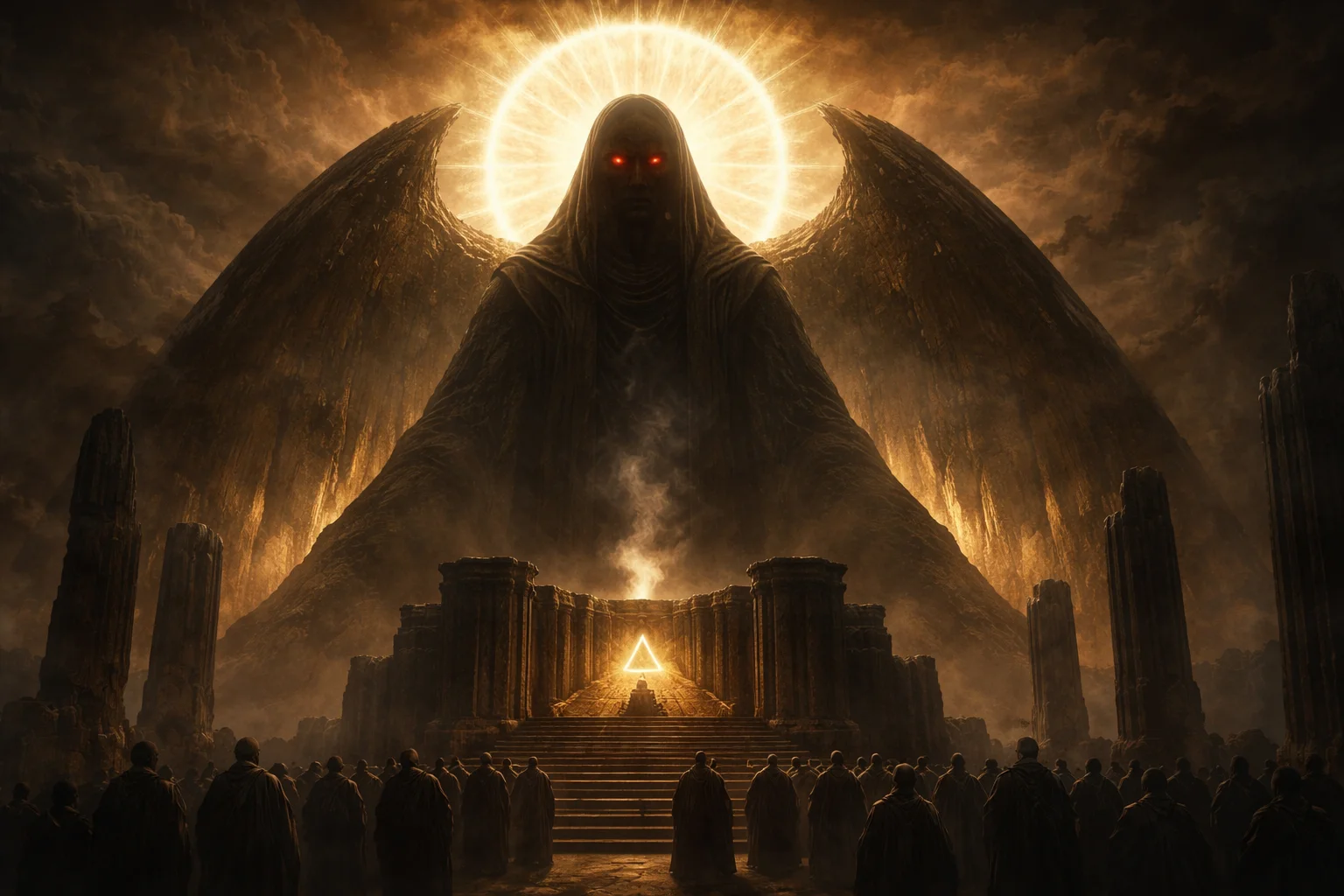
In Gnostic texts, the creator of the physical world is referred to as the Demiurge.
Not a devil. Not pure evil. But something far more unsettling:
A flawed creator.
A being that believes itself to be the highest authority.
A being that demands worship and obedience.
A being that governs through rules, hierarchy, and consequence.
Not out of perfect wisdom—but out of limitation.
In some interpretations, the Demiurge is ignorant of a higher reality.
In others, it actively prevents humans from discovering it.
Either way, it is not the ultimate source of truth.
A Comparison
Now, remove labels for a moment.
Consider a creator who:
- Declares itself the only god
- Demands exclusive worship
- Creates a world filled with suffering and limitation
- Establishes strict laws and punishes disobedience
- Frames obedience as virtue and questioning as failure
Seen through one lens, this is divine order.
Seen through another, it begins to resemble control.
The Gnostic perspective does not claim certainty.
But it offers a reframing that aligns more cleanly with the contradictions.
Instead of asking, “Why would a perfect God allow this?”
It asks, “What if the creator is not perfect?”
Reinterpreting Good and Evil
This shift changes everything.
If the creator is flawed, then suffering is no longer a test with hidden meaning—it is a byproduct of an imperfect system.
If obedience is demanded, it is not necessarily because it is good—but because it maintains control.
If questioning is discouraged, it is not because truth is dangerous—but because it leads beyond the system itself.
In this framework, the highest form of divinity is not authority—but truth.
Not control—but awareness.
Why This Perspective Persists
Gnosticism has never been the dominant view. In many cases, it was actively suppressed.
But the idea continues to resurface.
Not because it is convenient—but because it resolves something that traditional frameworks struggle with:
It does not require the justification of suffering.
It does not require the merging of love and punishment into a single concept.
It does not require blind acceptance of contradiction.
Instead, it separates them.
A Different Question
Maybe the question isn’t whether God exists.
Maybe it’s whether the being described as God is truly the highest form of divinity—or simply the one that claimed the position.
And if that distinction exists, then belief itself becomes something else entirely.
Not obedience.
But what it may have been at its beginning: an investigation of reality.
Leave a Reply