
The more I think about the ‘Out of Africa’-Theory, the less I like the clean version.
You know the image. Africa on the left. Arrows going north. Then east. Then Europe, Asia, Australia, and eventually everywhere else.
It look like a strategy game.
But ancient humans probably did not move like that. They did not look at the horizon and say, “Let us expand into Eurasia.”
People usually move because something pushes them.
Hunger. Climate. Conflict. Too many people in one place. A river changing course. A bad season. A fight inside the group. A neighboring group getting stronger.
So I want to play with another idea.
What if the successful Out of Africa expansion was not mainly about walking out of Africa?
What if it began much earlier, inside Africa, as a cultural solution to conflict?
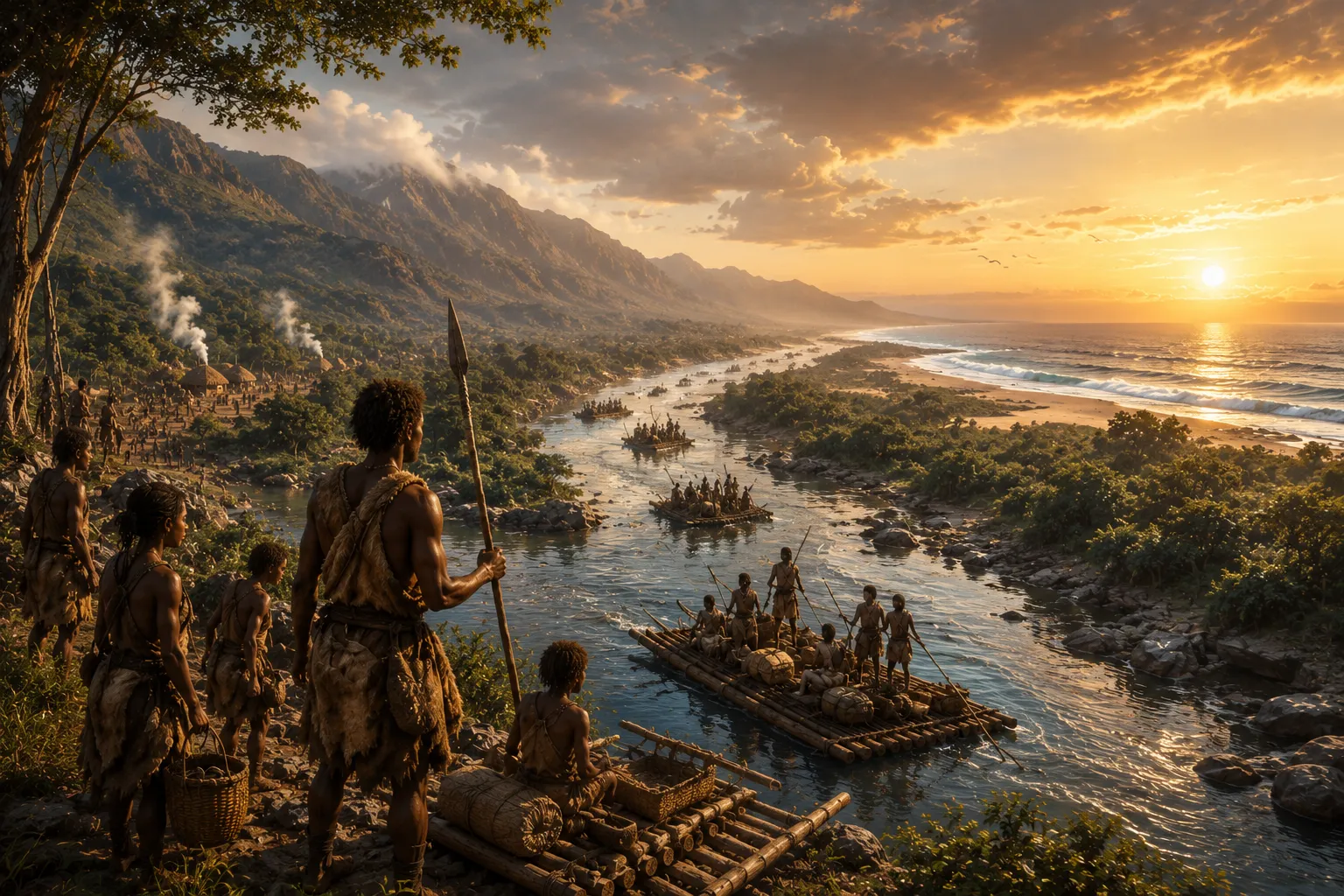
And what if the key people were river people?
Not in some fantasy sense. Just humans who got very good at living with water.
Start with many human worlds
Early Homo sapiens did not live as one big people.
That is important.
There was no single “human culture.” There were many groups. Many landscapes. Many ways of surviving.
Some groups lived near coasts. Some near rivers. Some around lakes and wetlands. Some in open savanna. Some in forests. Some followed herds. Some probably moved a lot. Some probably had more stable home ranges.
Over time, these groups would not just look different in small ways. They would also think differently. They would know different animals. Different plants. Different dangers. Different routes. Different seasons.
A desert group and a river group are not doing the same life.
They are both human. But their worlds are not the same. They might share some things here and there but their culture and way to be is highly influenced by their habitat. much more so than today. and what we call culture today, is more akin to a survival software to them.
How do you move?
What do you eat when the hunt fails?
Who gets to mate?
Who gets punished?
How to handle a conflict?
Do you attack neighbors, avoid them, trade with them, or marry into them?
Those answers decide who survives long term but not always in a logical way.
When a group gets too successful, trouble starts
Imagine a group does well.
They have enough food. Children survive. The group grows.
That sounds good. But growth creates pressure.
More mouths. More hunters. More status fights. More need for territory. More need for mates. More chance of internal conflict.
At some point, a growing group runs into limits.
And one very old solution is violence.
You push into another group’s land. You raid. You kill. You scare them away. You take the water source, the hunting ground, the good camp and the fruit trees.
This is not some cartoon caveman idea. We see territorial violence in chimpanzees. Chimp groups can attack neighboring groups, kill rivals, and expand their territory. Humans are not chimpanzees, obviously. Human culture is much more flexible. But we share enough deep social machinery that the comparison matters.
So I think early Homo sapiens groups probably had long periods where no one clearly dominated.
A group rises. It expands. It hits another group. There is conflict. A weaker group is pushed away. Maybe they die. Maybe they move. Maybe they return later. Maybe they mix. Maybe they vanish.
This could go on for thousands and thousands of years.
Not one clean expansion.
More like pressure waves.
Then river people become unusually successful
Now add rivers.
A river group has some huge advantages.
A river is food. Fish, shellfish, birds, eggs, reeds, plants, animals coming to drink. It is also water, obviously. It is a route. A border. A hiding place. A meeting place. A memory line through the landscape.
And most important for this idea: a river lets you move stuff.
Not with modern boats. I do not mean sails and proper ships.
I mean basic floating structures. Logs. Bundles of reeds. Planks. Dugouts later, maybe. Rafts. Things that float enough to carry tools, children, food, hides, fire material, and whatever else matters.
Many act like we only started to use water for movement after the invention of boats, when in reality the concept of logs floating on water is much easier to understand than making fire and we are making fire since 1 million years by now.
Even a bad raft changes everything.
If you live fully on land, moving camp is brutal. Everything has to be carried by bodies. Even if you use animals, you aren’t getting away with your stuff if attacked. You defend your possession or you save your life with the bare minimum or even less.
But if you live with a river, the river can carry weight for you.
That means your group can own more useful things. It can move and escape with more supplies. It can split and reconnect. It can send people downstream and still imagine a route back.
That is a different kind of life.
If a land group attacks you, the river gives you options. You can move away. You can cross. You can disappear into reeds, islands, floodplains, side channels. You do not have to meet every threat head-on.
Those people can only be beaten by their own kind, water people. So in the beginning river people may have been hard to eliminate.
Not invincible. But very slippery.
They have resources. Mobility. Escape routes. Transport. And a landscape that rewards knowing the water.
But success brings the same old problem
River groups would still face population pressure.
Maybe even more so.
If river life is rich, people survive. If people survive, the group grows. If the group grows, pressure rises.
The usual answer is still conflict.
Push someone else away. Take their stretch of river. Take their floodplain. Take the better fishing place. Take the crossing.
But river life also offers another answer.
Leaving.
That sounds simple, but it is huge.
For a land group, leaving may mean walking into death. For a river group, leaving may be more normal. You can move with the current. You can carry more. You can follow a visible path. You can stop at banks, islands, wetlands, estuaries, and lakes.
So maybe river people were more likely to develop a culture where splitting off was not impossible.
Still dangerous. Still painful. But not death.
And here the theory gets interesting.
Exile starts as punishment
I do not think the first version was noble.
I think it may have started ugly.
When a group gets too crowded or tense, the losers leave.
The defeated faction leaves.
The troublemakers leave.
The young men who lost the status fight leave.
The family that started too many problems leaves.
The weak side of an internal conflict leaves.
It is a war without blood.
Instead of killing your own people, you push them out.
That could be useful. The main group avoids internal collapse. It does not waste lives in a full fight. It lowers pressure. It keeps the best territory.
And neighboring groups may even prefer this.
A group that handles its own pressure by sending people away is less dangerous than a group that handles pressure by attacking neighbors.
So these “exiling” groups might become weirdly tolerated.
Not loved in some romantic sense. Just less threatening.
If you are a neighboring group, who scares you more?
The group that keeps raiding your land when it grows?
Or the group that sends its own people away downriver?
In military terms, you worry about the expanding killer first. Not the people bleeding off population into the distance.
So the exile strategy has an advantage.
It reduces rivalry.
It makes the main group less likely to be attacked by coalitions of neighbors.
And as long as the group keeps sending people away, it can keep growing without constantly triggering war.
Most exile groups would fail
But now look at the people being sent away.
Most of them probably die out.
Because founding a new group is hard.
You need enough people. You need both sexes. You need children. You need good hunters. Good gatherers. Toolmakers. Fire knowledge. Social trust. Knowledge of water, weather, animals, plants, and danger.
A defeated group does not always have that.
It may be angry, broken, too small, badly balanced, or full of people who did not want to leave.
Even with tools and some food, many would fail.
That could explain something we already see in the evidence.
Modern humans appear outside Africa earlier than the main successful expansion. Misliya Cave in Israel has a Homo sapiens jaw dated to around 177,000 to 194,000 years ago. Other early modern humans were in the Levant too. And Al Wusta in Arabia gives us Homo sapiens outside Africa and the Levant before about 85,000 years ago.
So humans were leaving Africa before the later expansion that gave rise to most non-Africans today.
But those early expansions did not become the big surviving lineage.
Why?
Maybe because many were not real founding expansions.
Maybe some were pressure leaks.
Small groups. Pushed groups. Failed groups. Brave groups, sure. But not stable enough to become a lasting world population.
They reached places. They survived for a while. Then they vanished, mixed, or were replaced.
That already makes the Out of Africa story feel different.
Not one migration.
Many attempts.
Most dead ends.
Then one river culture changes the rule
Here comes the twist.
At some point, one group may have reversed the logic.
Instead of sending away the losers, they sent away the capable.
That is the whole theory.
And it is such a simple change, but it changes everything.
If you send out your weakest people, they fail.
If you send out your strongest founders, they may survive.
Not the strongest in a macho sense. I mean the most capable mix of people.
Good hunters. Good toolmakers. People who know water. People who can care for children. People who can keep peace inside a small group. People who can read land and weather. People who can remember routes. People who can make fire, repair things, and keep stories alive.
That is no longer exile.
That is founding.
And once a culture discovers founding, it has solved a huge problem.
It can grow without eating its neighbors.
It can reduce internal pressure without throwing away broken people.
It can reproduce itself outward.
The daughter group carries the parent culture. Maybe not perfectly. Cultures change. But enough.
Enough tools. Enough language. Enough marriage rules. Enough memory. Enough identity. Enough survival skill.
Now the river is not just an escape route.
It becomes a birth canal for new groups.
This would take thousands of years
I do not imagine this as one genius decision.
Nobody wakes up and invents global expansion.
It would be slow.
First, groups split badly.
Then they split with help.
Then splitting becomes normal.
Then some splits survive better than others.
Then people notice which kind of group survives.
Then the culture starts sending better-balanced groups.
Then founding becomes honorable, or at least accepted.
This could happen over thousands of years.
And rivers are the perfect place for that cultural experiment.
Because river people already know how to leave.
They already live with movement. They already use water as transport. They already understand that a group can be here today and farther downstream later. They already have a landscape where splitting does not always mean total disappearance.
A land group may think: leaving means death.
A river group may think: leaving means distance.
That difference is massive.
From river to coast
Eventually rivers lead somewhere.
Many lead to lakes. Wetlands. Deltas. The sea.
And once a river people reaches the coast, the same logic can continue.
A coast is basically a river with one side missing.
You can follow it. You can eat from it. You can camp along it. You can move in stages. You can use estuaries and river mouths as stepping stones.
This is why the coastal route idea matters.
Some researchers already take seriously the idea that Homo sapiens moved along coastlines during parts of the Out of Africa expansion. Not necessarily like sailors. More like shoreline people. People who knew how to use beaches, reefs, shellfish, fish, birds, freshwater outlets, and tides.
We also know early humans used coastal resources very early. At Pinnacle Point in South Africa, there is evidence for marine food use around 164,000 years ago.
That does not prove this theory.
But it points in the right direction.
Humans were not just plains hunters. Some were already learning the edge between land and water.
And that edge may have been one of the most important places in human history.
The successful expansion needed a full package
This is where the theory meets the bigger scientific picture.
The later successful Out of Africa expansion seems to happen after humans had become more flexible inside Africa.
There is newer work suggesting that before the successful expansion after around 50,000 years ago, Homo sapiens had already expanded into more diverse African habitats. Forests. Deserts. Grasslands. Coastal zones. Different ecological worlds.
That matters because a founding group needs flexibility.
If you are going to leave the old home range, you cannot depend on one perfect environment. You need to adapt fast.
A loser exile group may not manage that.
A selected founder group might.
Especially if it comes from a culture already used to movement, splitting, water routes, and survival in changing places.
This could also help explain why modern humans eventually did better than other human groups like Neanderthals.
Not because Neanderthals were stupid. They were not.
And not because modern humans simply killed them all. That is too simple.
Modern humans and Neanderthals met. They mixed. Most non-Africans today have some Neanderthal ancestry.
So the story was not pure war. It was contact, competition, interbreeding, avoidance, climate stress, and probably different social systems.
A strong founding culture could survive that better than a fragile exile group.
It could keep moving. Keep contact. Keep exchanging information. Keep forming new daughter groups.
That may be the real advantage.
Not better bodies.
Better social reproduction.
So the theory is this
Early modern humans in Africa split into many local cultures, each adapted to different landscapes.
When groups became too successful, population pressure created conflict. Many groups probably expanded by attacking or pushing out rivals.
River groups had a special advantage. They had food, transport, escape routes, and the ability to move more material than land groups. This made them resilient and mobile.
Over long periods, some river cultures may have developed a pressure-release strategy: send people away instead of constantly fighting neighbors.
At first, this was probably exile. The losers left. Most failed.
But the strategy still helped the parent group, because it reduced rivalry and made the group less threatening to neighbors.
Then one branch changed the rule.
It stopped sending away only the losers.
It sent capable founders.
And that turned exile into expansion.
Those founder groups could move along rivers, wetlands, deltas, and coasts. They had enough skill and social structure to survive. Most still failed, but enough survived to keep the chain going.
Eventually, one of those chains became the successful Out of Africa expansion.
Not because they planned to claim Earth.
Because their culture had learned how to make leaving work.
Why this feels believable to me
The theory is speculative. Obviously.
We do not have a sign carved into a rock saying, “Here we invented founder groups.”
But it fits a lot of pieces.
It fits the fact that Homo sapiens left Africa more than once.
It fits the fact that some early expansions seem to have failed.
It fits the importance of rivers, coasts, and drowned shorelines.
It fits the idea that population pressure creates conflict.
It fits the idea that culture can solve biological problems.
And it makes the final expansion feel less like a miracle.
The old picture is too simple: humans walk out, humans win.
This version is messier.
Humans split. Fight. Fail. Move. Learn. Try again. Some groups become good at water. Some groups use exile as pressure release. Most splinters die. Then one culture reverses the whole logic and sends its best people outward.
That is the moment the story changes.
The losers leaving creates dead ends.
The best leaving creates new worlds.
Maybe the people who spread across Earth were not the ones who stayed to defend the old place but the ones trusted to carry it somewhere else.
Leave a Reply